

Director of the Colorado Division of Water Resources Jason Ullmann provided an overview of current Arkansas River Basin water issues during the September board meeting of the Upper Arkansas Water Conservancy District in Salida.
Commonly referred to as the State Engineer, Ullman oversees the administration of Colorado’s water resources – everything from dam safety and well permits to streamflow data and water resource studies.
Ullman focused on two Ark Basin issues – futile calls and illegal ponds – both of which tie into the Arkansas River Compact of 1948 between Colorado and Kansas, which established legal protections for river flows at the state line.
Futile Calls
A “call” occurs when the owner of a water right fails to receive the full allotment of water to which they are entitled. When that water-right owner “calls” for more water, newer, or more junior, water-right owners must stop using water so that the more senior right receives it’s full allotment.
A futile call determination allows a junior user to divert water in spite of a call from a more senior right when that water would not reach the downstream right at the time and place of need.
The division engineer is responsible for making that determination, and an increased understanding of the interconnectedness of surface water and groundwater has called into question futile-call designations in the Arkansas Basin.
Ullman said that a futile call “probably can’t be considered futile if it’s more junior than the Compact.”
Division 2 Engineer Rachel Zancanella said the futile call analysis was undertaken to determine legitimate futile calls versus calls that were traditionally considered futile but are being shown not to qualify based on a better understanding of the relevant hydrology.
“Some futile calls may still be futile,” she added.
Illegal Ponds
Upper Ark Board Chair Tim Canterbury asked Ullman about “the pond issue,” referencing Arkansas Basin ponds that are impounding water without a legal right to do so.
“There are illegal ponds in every basin in Colorado,” Ullman said, adding that the Division of Water Resources has inventoried ponds in Custer County and is working to find a legal way for people to keep their ponds.
Ullman said water administration is different in the Ark Basin because of the way the Arkansas River Compact is written (compared to other interstate agreements like the South Platte River Compact with Nebraska).
“Those ponds are depleting water through evaporation,” he said, which affects the amount of water delivered to Kansas.
Zancanella said, “It’s a really challenging thing to do, and we’re trying to take a collaborative approach” to minimize the costs of allowing these ponds to legally impound water.
“In a lot of cases, the cost to comply is prohibitive,” she said. The hope is that a collaborative approach between property owners with ponds will make it easier pay for the cost of replacing water lost to evaporation.
But if the evaporative water losses from a pond can’t be replaced by purchasing augmentation water, the Division of Water Resources has the authority to breach those ponds’ dams. The DWR would also seem to be under a legal mandate to breach those dams based in part on the Arkansas River Compact.
The DWR’s work in Custer County serves as a pilot project, and Ullman said the DWR is starting to have conversations with pond owners in Lake and Pueblo counties.
“This is a very specific issue that Kansas raised,” Ullman said. “We expect to have a preliminary report in the next couple of months.”
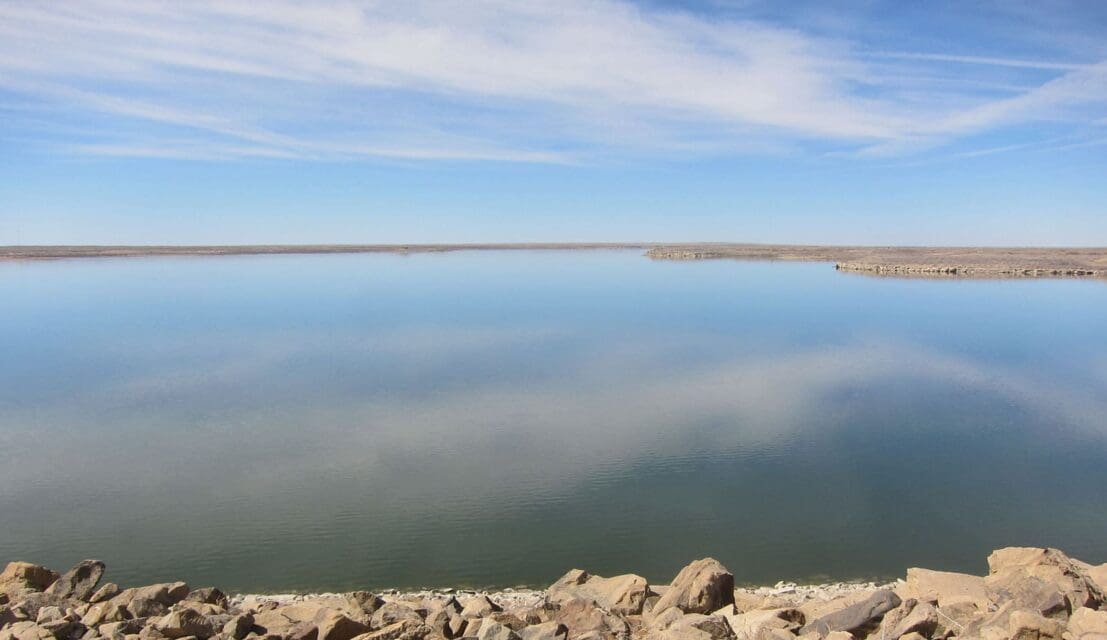
Photo: John Martin Reservoir, impounded by a dam built between 1939 and 1948 near Las Animas by the U.S. Army Corps of Engineers, plays a key role in administration of the Arkansas River Compact between Colorado and Kansas (photo courtesy of WIkipedia).