

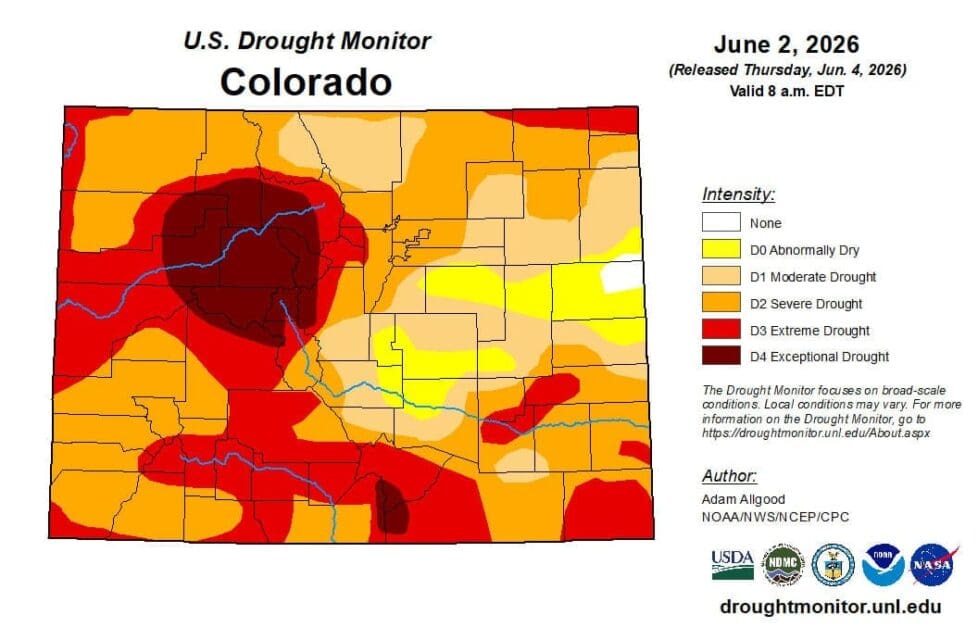
Gov. Jared Polis declared a statewide drought emergency and activated Phase 3 of Colorado’s Drought Response Plan Thursday, June 4, “in response to worsening drought conditions driven by record-low snowpack and prolonged warm temperatures across Colorado.”
The Colorado Drought Task Force and the Water Conditions Monitoring Committee recommended the actions “after months of monitoring water and worsening drought conditions statewide,” according to a statement from the Governor’s Office.
“Today I am issuing a statewide drought emergency … in the face of one of the most severe droughts in Colorado’s recorded history. … Activating Phase 3 of our Drought Response Plan allows us to better coordinate agencies, prepare for worsening conditions, and support Colorado communities, agriculture, water users, and our environment. … I strongly encourage every Coloradan to use water wisely,” Polis said.
Since March, Colorado has been under Phase 2 of the Drought Response Plan, which formally convened the state’s Drought Task Force. Phase 3 activation allows the state to take additional emergency actions, including “potential emergency funding for unmet response needs, a potential request for a federal disaster declaration, and reductions in outdoor water usage at state facilities.”
According to the June 4 report issued by the U.S. Drought Monitor nearly 93% of the Colorado is experiencing moderate to exceptional drought.
Following the lowest snowpack accumulation season on record, streamflow forecasts project runoff ranging from 21-37% of median statewide. Additionally, the current water year, which began Oct. 1, 2025, has been the warmest on record, “contributing to early snowmelt, extremely low river flows, diminished soil moisture conditions, and elevated wildfire risk statewide.”
Department of Natural Resources Executive Director Dan Gibbs said, “State agencies, water managers, and local partners across Colorado have been working closely together for months to prepare, coordinate resources, and respond proactively.”
With the Phase 3 drought response in place, the Drought Task Force will meet regularly to “monitor conditions, coordinate interagency response efforts, identify unmet needs, elevate local impacts, and share drought resources and support.” The Task Force will evaluate requests for additional support or funding, which must be tied to specific needs and response actions. Requests will be “elevated to the Governor as necessary.”
Lauren Ris, director of the Colorado Water Conservation Board, said, “The state has been actively preparing for evolving drought conditions throughout the season and for the last decade has supported Colorado communities and water users in becoming more drought resilient.”