

As the keynote speaker at the Arkansas River Basin Water Forum in Salida, Upper Colorado River Commissioner Rebecca Mitchell spoke about the Colorado River crisis and water-use negotiations among the seven Colorado River Basin states.
Following a warm winter with the lowest snowfall on record, Colorado faces a dire water-resource challenge. Mitchell acknowledged these unprecedented conditions and repeatedly avowed hydrologic reality in the Colorado River Basin as the basis for administering water use.
The 1922 Colorado River Compact governs water allocations in the Colorado Basin and delineates Upper Basin states – Wyoming, Utah, Colorado and New Mexico – and Lower Basin States – Nevada, Arizona and California.
Negotiated during one of the Basin’s wettest known climate patterns, the Compact allocates 7.5 million acre-feet of Colorado River water to the Upper Basin states. The Lower Basin allocation is 7.5 million acre-feet from the Upper Basin plus a million acre-feet from Lower Basin tributaries.
“Let’s look at the numbers,” Mitchell said. “Even in the most recent years … with reservoirs near the brinks of collapse,” Lower Basin water use was almost 11 million acre-feet in 2021, 2.5 million acre-feet more than the Lower Basin’s allocation. That overuse is based on “a very flawed legal opinion,” not science.
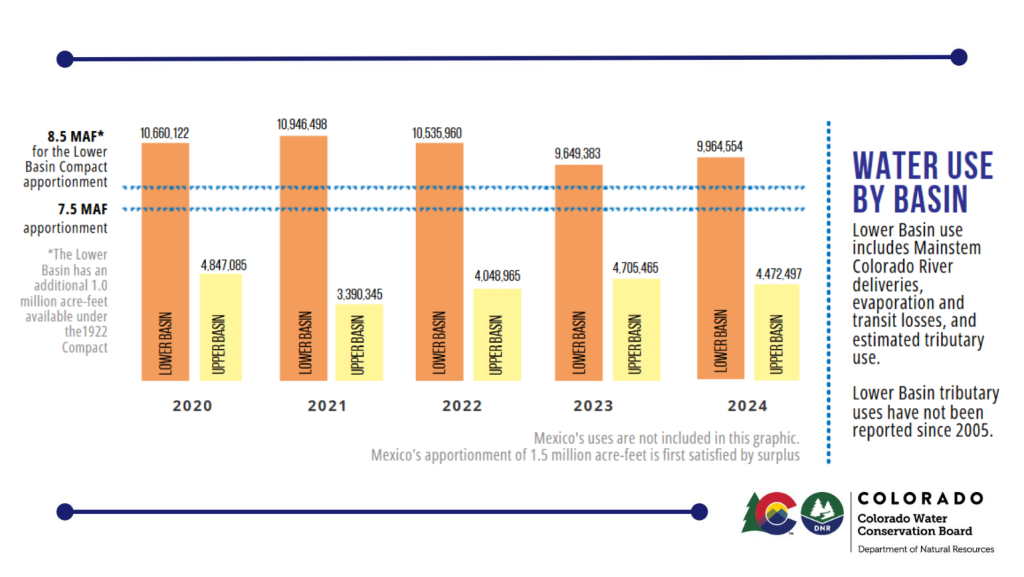
By contrast, the Upper Basin states cut usage by almost a million acre-feet from the previous year, using less than 4 million acre-feet, or 3.5 million acre-feet less than their allocation.
Mitchell also compared annual water flows into Lake Powell with the amount of water that the U.S. Bureau of Reclamation released from Lake Powell. “Sixteen out of 20 years, more water left Lake Powell than came in. That mass balance equation simply doesn’t work.”
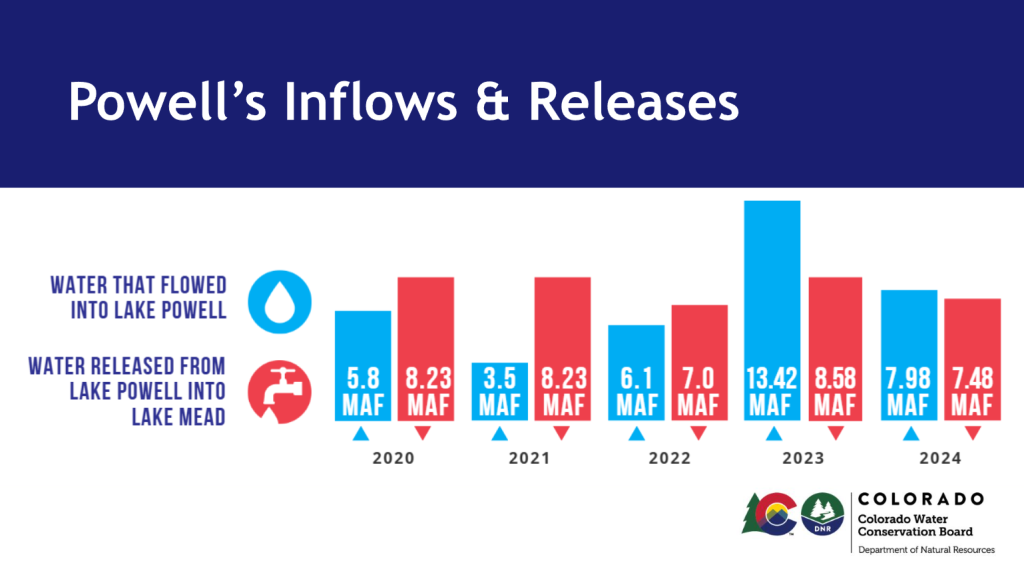
Those excessive water releases “were not tied to what was happening with hydrology,” she said. “They were tied purely to the reservoir elevations” established by the 2007 Interim Guidelines “and releases that were desired by the Lower Basin.”
Other numbers Mitchell cited include reservoir levels for recent years in which the Lower Basin states used more than their water allocations under the Compact.
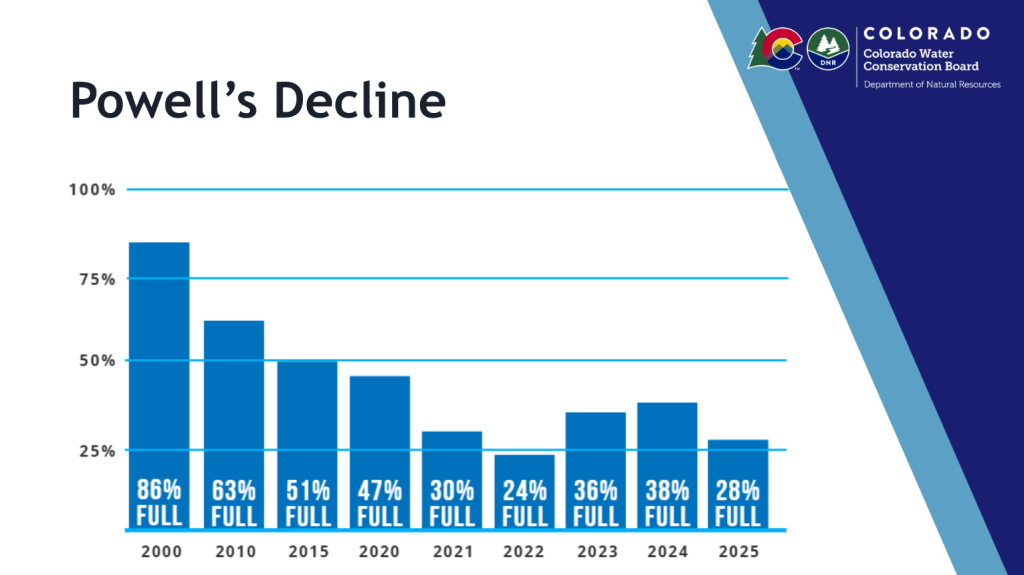
In 2000, “you can see Powell is about 86% full. And you look at where we are in 2025, and we’re predicted to be in an even worse situation at the end of this year. … This didn’t work. You see a steady decline.”
The Interim Guidelines “incentivized pulling down Meade so more water would come from Lake Powell. That put us in the situation that we are in today,” Mitchell said. “These guidelines didn’t respond to real world hydrology. They incentivized use – unsustainable use … and they prioritized one basin over the other” – i.e., the Lower Basin over the Upper Basin.
As a result, “two countries are struggling. Forty million people are struggling. Thirty tribes haven’t been at the table before this, (and they) deserve to be. This wasn’t the way to get security for the Western United States.”
The solution, she emphasized, is having flexibility to adapt to changing conditions across the entire Colorado Basin by planning for variable operations. Colorado’s Prior Appropriation (Priority) System, embedded in the Colorado Constitution, requires that flexibility.
Colorado’s Priority System has produced a system of year-round real-time administration of water use based on legal priority.
“You all know the Priority System,” Mitchell said. “There is a priority system in the Lower Basin” that “has been used … yeah, zero times. …
“I think the truth is important, and facts are important. Science is important. … (The Lower Basin’s) overuse essentially put us in the situation that we are in today. … We’re in this together. But we have to pivot to that.
“And we have to engage the tribal nations and Mexico. We can’t do this the way that we have done it before. … One user is not more important than the other users, one side of the Basin is not more important than the other side of the Basin.”
Upper Basin states, led by Colorado, have proposed multiple collaborative, science-based approaches to resolving the Colorado River crisis, but “the Lower Basin is coming up with yet another one of their own plans that involve our resources. …
“They’re irresponsible. They’re not doing enough.” Their rhetoric “puts all of us at risk. And I think we have the responsibility to do better. … One of the things that we’ve always done is really look at what we can do based on the resources that we have – the systems that we already work under.”
Mitchell insisted that the Upper Basin states had put on the table “a generous rule curve of releases from Powell” as well as upstream reservoirs like Blue Mesa and Flaming Gorge.
“Now that we know a year like this is possible, we need to factor that in and be prepared for that. … We have to figure out how do we save in the good years so we can get through the years like this year? …
“I was just in Grand Junction. I had grown men come to me crying. They know this year is going to suck. Literally. And if we don’t acknowledge that as part of our path forward, then we’re really not acknowledging who we are, and we’re also not acknowledging what needs to be done.”