

I-70 Mountain Corridor, mountain passes and foothills face winter driving conditions Thursday night through Saturday morning
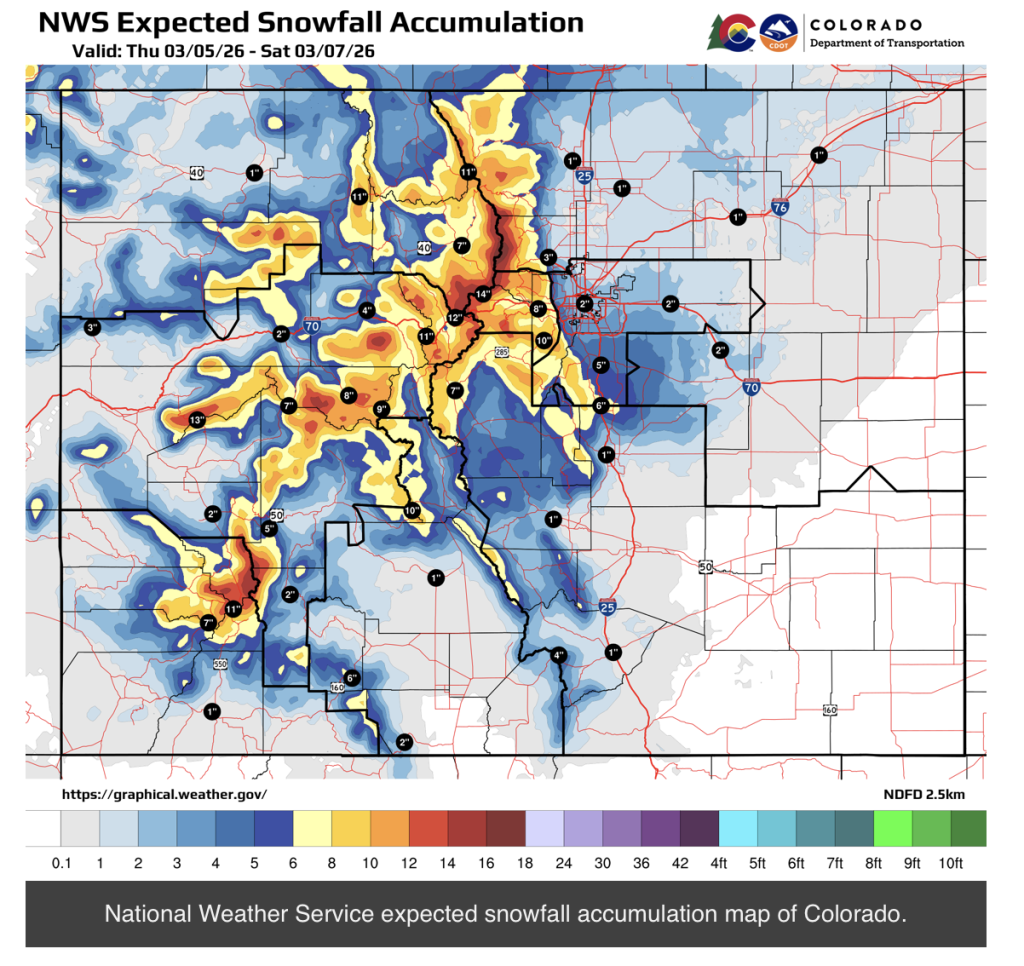
Statewide – After an extended stretch of dry conditions, Colorado’s first significant spring storm arrives tonight, Thursday, March 5. A developing trough west of Colorado will bring a healthy burst of snow through Friday before weakening Saturday morning, producing winter impacts for many Colorado roadways. The cold front rapidly expands snowfall across the mountains and valleys Friday morning, with lighter showers lingering into Saturday south of Interstate 70.
While Colorado Department of Transportation crews will be out plowing and treating roads, pavement may be slick and motorists should be prepared for winter driving conditions across mountain corridors, the foothills and portions of the eastern plains. Check COtrip.org or the COtrip Planner app before heading out, avoid or limit driving during the height of the storm, ensure tires have adequate tread and pack a survival kit including blankets, food, water, a flashlight, chargers and windshield wiper fluid.
Chain and Traction Laws
Failure to follow Colorado’s chain and traction laws is a leading cause of delays, safety closures and crashes during winter weather events. CDOT’s main concern during this storm is ensuring all drivers, especially commercial motor vehicles, chain up when the chain law goes into effect. Motorists must be prepared for traction and chain laws to go into effect along the I-70 Mountain Corridor and other affected highways at any point during this storm.
During a traction law, all motorists are required to have:
- All-wheel drive (AWD)/four-wheel drive (4WD) vehicles with tires designated as mud and snow (mountain-snowflake icon or M+S or M/S denoted) and 3/16-inch tread depth, or
- AWD/4WD vehicles with winter tires (mountain-snowflake icon or M+S or M/S denoted) and 3/16-inch tread depth, or
- AWD/4WD vehicles with an all-weather rating by the manufacturer and 3/16-inch tread depth, or
- Chains or an approved alternative traction device.
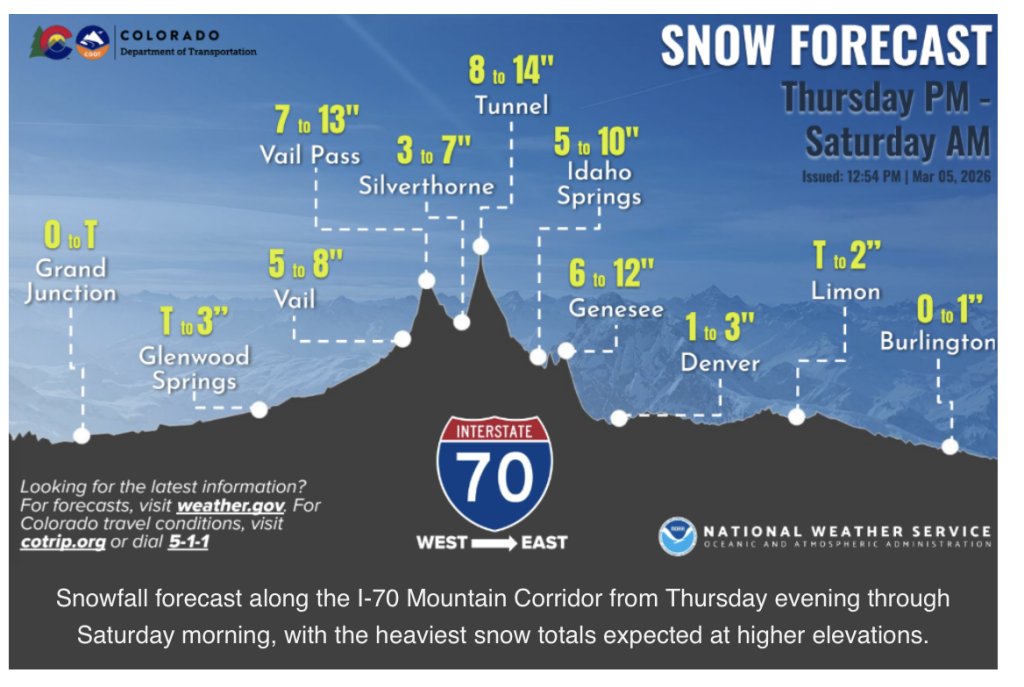
Failure to follow Colorado’s chain and traction laws is a leading cause of delays, safety closures and crashes during winter weather events. CDOT’s main concern during this storm is ensuring all drivers, especially commercial motor vehicles, chain up when the chain law goes into effect. Motorists must be prepared for traction and chain laws to go into effect along the I-70 Mountain Corridor and other affected highways at any point during this storm. During a traction law, all motorists are required to have: All-wheel drive (AWD)/four-wheel drive (4WD) vehicles with tires designated as mud and snow (mountain-snowflake icon or M+S or M/S denoted) and 3/16-inch tread depth, or AWD/4WD vehicles with winter tires (mountain-snowflake icon or M+S or M/S denoted) and 3/16-inch tread depth, or AWD/4WD vehicles with an all-weather rating by the manufacturer and 3/16-inch tread depth, or Chains or an approved alternative traction device. I-70 Mountain Corridor/ US 40 Berthoud Pass Drivers should be prepared for icy and snow-packed conditions over the passes adjacent to the interstate and the Eisenhower-Johnson Memorial Tunnels approach through much of Friday, March 6. Storm totals up to 8-12 inches will favor the Northern Mountains near the Continental Divide, with the Central Mountains from the Divide down through the foothills also seeing substantial accumulations. Snowfall shifts south of I-70 Friday night, but weekend ski traffic will be impacted from the foothills through Vail Pass, with residual effects possible Saturday morning. Allow extra travel time, check COtrip.org for active traction laws and real-time conditions and never drive around a CDOT closure gate. Skiers and riders are encouraged to take transit, such as Bustang, Snowstang and Pegasus, which will drop passengers off at popular ski areas. Denver Metro Expect a quick turn in weather Thursday night with rain switching to snow early Friday morning. Residual road heat will keep lower elevation corridors wet through much of the morning commute, with slush possible under heavier snow. Roads will be slick in the central and southern foothills and along Interstate 25 south of Castle Rock, with the heaviest impacts over the Palmer Divide. Snow winds down by Friday evening, but impacts may creep in from the south and west Friday night. South- and Central Front Range Snow will hit the south- and central Front Range Thursday evening through Friday morning. Roads will be icy and snow packed in the southern foothills, US 24 and I-25 north of Colorado Springs along the Palmer Divide. Impacts may linger through Friday evening into Saturday morning. Southwest Colorado Snow will be widespread Friday, lingering longest over the eastern San Juans. US 50 Monarch Pass and US 550 mountain corridor will likely see the greatest impacts. Travelers will encounter slick and snow-packed roads with poor driving conditions possible into Saturday morning. Snow conditions may require additional maintenance work and safety closures at any time on many southwest Colorado highways. Know Before You Go Travelers are urged to “know before you go.” Gather information about weather forecasts, anticipated travel impacts and current road conditions before hitting the road. CDOT resources include: Road conditions and travel information: COtrip.org Download the free COtrip Planner app: bit.ly/COtripapp Sign up for travel alerts: bit.ly/COnewsalerts Check weather forecasts: weather.gov Check for avalanche conditions at CAIC: www.avalanche.state.co.us Connect with @ColoradoDOT on social media: Twitter, Facebook, Instagram and YouTube. Download the COtrip Planner App! The free COtrip Planner mobile app was designed to meet the growing trend of information on mobile and tablet devices for the traveling public. The COtrip Planner app provides statewide, real-time traffic information, and works on mobile devices that operate on the iOS and Android platforms. Visit the Google Play Store (Android devices) or the Apple Store (iOS devices) to download! About CDOT’s Division of Maintenance and Operations The vision of the Division of Maintenance & Operations (DMO) is to create one integrated division. The division focus is on real-time maintenance and operations services, as well as near-term improvement projects. We can best support the crucial work of our five CDOT regions. Our support helps to provide the optimal service and safety for the traveling public in Colorado. CDOT’s DMO – we do more than you think. About CDOT The Colorado Department of Transportation’s mission is to provide the best multi-modal transportation system that most effectively and safely moves people, goods and information. CDOT maintains more than 23,000 lane miles of highway, more than 3,400 bridges and 35 mountain passes. Our team of employees works tirelessly to reduce the rate and severity of crashes and improve the safety of all modes of transportation. CDOT leverages partnerships with a range of private and public organizations and operates Bustang, an interregional express bus service. Find more details at codot.gov. |